
01
Prepare the offer
Select SINs, organize administrative and technical documents, gather past performance, and build pricing support.
GSA SCHEDULE GUIDE
Understand the requirements, offer process, pricing preparation, and first steps after award.
Getting a GSA Schedule is not a simple “application.” You prepare a formal offer against the MAS solicitation, submit through eOffer, and negotiate pricing and terms before award.
To get on the GSA MAS Schedule, you select the right SINs, compile required documentation and pricing support, and submit your offer in GSA’s eOffer system. GSA reviews you as a responsible vendor, negotiates terms, then awards the contract if pricing and compliance are acceptable.
Submission system: eOffer/eMod is GSA’s online tool for submitting offers and mods.
Required training: GSA’s roadmap references mandatory “Pathways to Success” training and an eOffer acknowledgement when submitting.
After award: Plan catalog setup, internal ownership, and ongoing contract administration.
01
Select SINs, organize administrative and technical documents, gather past performance, and build pricing support.
02
Submit through eOffer, respond to clarification requests, and work through pricing and terms.
03
Confirm contract details, prepare your catalog, establish eBuy access, and plan buyer outreach.
04
Keep contract information aligned with what you sell, manage updates, and develop federal opportunities.
See how the process connects to practical support.
A successful GSA offer is less about filling out forms and more about proving three things: you are a responsible contractor, your offering fits the Schedule scope, and your pricing is reasonable and supportable. The checklist below summarizes the core components most contractors need to prepare before submitting through eOffer.
| Requirement | What it proves | Common pitfall |
|---|---|---|
SIN selection and offer alignment - Identify the right Special Item Number(s) (SINs) and align your products or services to them. |
You belong in the Schedule category you’re pursuing and buyers will find you in the right place. |
Choosing SINs that are “close enough” and then forcing your narrative to fit. |
Administrative and legal package - Complete the required representations, certifications, and administrative forms required by the MAS solicitation. |
You can legally do business with the government and you’ve followed solicitation instructions. |
Missing attachments, inconsistent entity info (UEI, addresses, POCs), or using outdated templates. |
Financial responsibility support - Provide financial documentation or narrative support showing stability and responsibility. |
You are capable of performing and managing a federal contract responsibly. |
Submitting financials without context or leaving questions about continuity unanswered. |
Past performance package - Provide relevant past performance references and supporting details that match what you are proposing to sell. |
You have demonstrated experience delivering similar work (or selling similar products) successfully. |
References that are too old, too generic, or not aligned to the SIN scope. |
Pricing and discounting support - Provide a clear explanation of how you price commercially and what discounts you offer, supported by documentation. |
Your proposed pricing is reasonable and defensible for the government customer. |
Discount logic that changes across documents, or a narrative that does not match the pricing spreadsheet. |
Technical narrative (scope and value) - Describe what you offer, how it maps to the SIN(s), and what differentiates you in a buyer-relevant way. |
Your offer is within scope and your value proposition is credible. |
Marketing copy that sounds good but does not clearly describe the deliverable or scope fit. |
Subcontracting plan (if applicable) - If you are other than small for the relevant NAICS, include a compliant subcontracting plan when required. |
You can meet small business participation requirements where applicable. |
Using a generic plan that does not match your operating model or realistic goals. |
System readiness (eOffer submission prerequisites) - Ensure the person submitting has the right access and documents are formatted and organized for eOffer upload. |
You can submit correctly and respond quickly to contracting officer requests. |
Getting blocked at submission due to access issues, missing signatures, or last-minute document scrambling. |
Pricing is the part of the GSA offer that most often drives questions, revisions, and negotiation cycles. GSA is not just checking that you filled out templates, they are evaluating whether your pricing is reasonable, supportable, and consistent with how you sell commercially. A clear pricing story can move your offer forward; a fuzzy one can put it in the “needs follow-up” pile.
What GSA is looking for:
Your job is to make it easy for a contracting officer to explain to their boss:
“Here’s what the contractor charges commercially, here’s how the discount works, and here’s why the government price is fair."
Supportable pricing means you can explain how you arrived at the proposed prices and back it up with evidence. For services, that often includes a logical relationship between your labor categories, qualifications, and rates. For products, it means your proposed prices reflect a real commercial basis and a consistent discount approach. The goal is not perfection; it’s a pricing position that holds together when someone asks reasonable questions.
GSA is trying to understand how you sell in the real world so they can judge whether your government pricing is fair and defensible. When discounting practices are unclear, inconsistent, or undocumented, negotiations tend to drag because the contracting officer has to keep asking, “What would your customer normally pay, and why?” The clearer your discounting rules are, the fewer loops the process usually takes.
Start by documenting your commercial pricing and discount structure in plain language. Keep your discount logic simple and repeatable, and ensure your narrative matches your pricing tables exactly. If your commercial model is messy, it can be cleaned up, but you want to do that before submission, not during negotiation. In short: fewer moving parts, fewer questions.
We help you build a pricing narrative that is consistent, clear, and easy to defend, then make sure your spreadsheets, supporting documents, and offer language all tell the same story. If the contracting officer raises questions, we respond quickly with targeted support rather than rewriting the offer from scratch.
Award is the starting line, not the finish. The first 30 days are where many contractors either get buyer-ready quickly or lose momentum because visibility steps, internal ownership, and processes are unclear. This checklist helps you get organized fast so your contract is accurate, discoverable, and easy to support.
Explore New GSA Contract Startup
Many people call it an “application,” but in practice it works more like submitting a formal offer. You are proposing to sell specific products or services under the MAS program at specific pricing and terms, and GSA reviews that offer for completeness, responsibility, scope fit, and pricing reasonableness. If GSA has questions, you respond with supporting documentation and revisions, and pricing and terms may be negotiated before award.
The key takeaway: you are not filling out a simple registration form. You are building a package that needs to be consistent across your narrative, forms, and pricing support so a contracting officer can approve it and document the decision.
Offers are submitted electronically through GSA’s eOffer system. It is the submission portal where you upload the solicitation-required documents, complete required acknowledgements, and formally submit the offer to GSA for review.
In practical terms, this means you need to be ready for two things: (1) having the correct access and credentials to submit without delays, and (2) having your documents organized and final, because contracting officer questions often require fast, targeted follow-ups. If access or formatting becomes a last-minute scramble, it can delay submission or slow the early part of the review.
Special Item Numbers (SINs) are the categories GSA uses to organize what contractors sell on the Schedule. Buyers search and compare vendors by SIN, and contracting officers review your offer based on whether what you propose is in scope for the SINs you select.
SIN selection matters because it shapes everything downstream: what documentation you provide, how you describe your services or products, how you position your past performance, and even how buyers find you later. Choosing SINs that are too broad, not quite right, or not supported by your narrative often creates avoidable review questions. A good SIN choice is one you can clearly support with your offering description and past performance.
After you submit, GSA conducts an initial review for completeness and responsibility, then moves into questions and negotiation. In most cases, you should expect a cycle of clarification requests, updates to documents, and pricing discussions. The contracting officer’s goal is to reach an award decision that is compliant and well-supported, and your goal is to respond quickly with clear, consistent support so the process keeps moving.
A useful way to think about it: submission is not the finish line, it is the start of a review-and-response phase. The more organized and consistent your offer package is, the fewer “round trips” you usually need.
Right after award, your priority is to become buyer-ready and establish a simple internal process so the contract stays accurate. That usually means confirming internal ownership (who manages the contract, who controls pricing changes, who handles modifications), aligning your sales team on what is actually on-contract, and getting your contract information properly presented for buyers through the current catalog and visibility steps.
You also want to start with a simple, realistic sales motion: identify target agencies, prepare reusable response content, and decide how you will respond to eBuy and other buyer inquiries. A contract can be awarded and still be “invisible” in practice if visibility steps are incomplete or if sales materials do not match what the contract allows.
Timelines vary, but most contractors should plan for a process that takes several months, and sometimes longer depending on offer complexity, how quickly you respond to questions, and how competitive your pricing support is. GSA’s own guidance notes that review, negotiation, and award can take up to 12 months in some cases, especially when packages are incomplete or pricing requires multiple negotiation cycles.
A practical way to manage expectations is to break the timeline into three parts: (1) your internal preparation time, (2) GSA review time, and (3) negotiation and revisions. If you want a faster cycle, the biggest controllable factors are submission completeness and a pricing narrative that is consistent and defensible from day one.
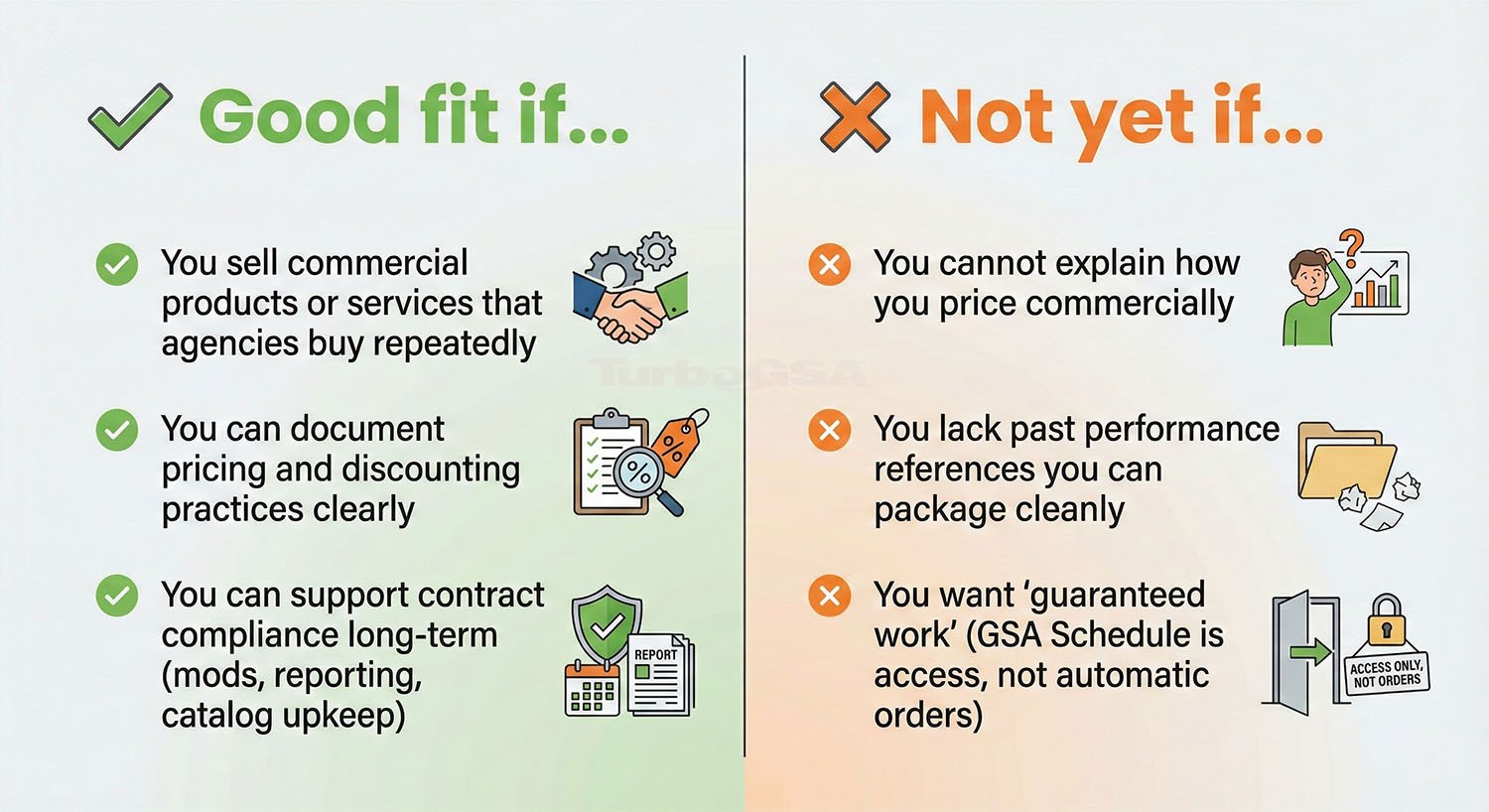
No. A GSA Schedule contract is a selling channel and a credibility credential, not a promise of orders. It makes it easier for agencies to buy from you because the contract terms are pre-negotiated, but agencies still have to find you, compare you, and decide you are the best value for their need.
The good news is that contractors who treat the Schedule like an asset, keep it accurate, and build a consistent sales motion (target agencies, respond to opportunities, and market within scope) are in the best position to generate results. The contract opens doors, but you still have to walk through them.
Most delays come from issues that create repeated clarification cycles. The most common ones are:
The simplest way to reduce delays is to build the offer the way GSA reviews it: confirm SIN fit, ensure administrative completeness, then tighten past performance and pricing so every part of the package tells the same story.
Go deeper on the questions that matter at your stage.
Choose the support that fits your stage.
Talk with us about your SINs, documentation, pricing preparation, and next steps.