
5 min read
For 20 years, every GSA Schedule came with an expiration date built in. Make it through the base period and all three options, and your reward was... writing a brand new offer and starting over.
Refresh 34 ends that. It also gives GSA a sharper stick for stale catalogs, draws a clear line around when the new AI clause applies, and introduces a domestic product certification that agencies aren't allowed to rely on yet.
There's plenty more in the refresh, but most of it won't change how you run your contract. Here's what will, what you can safely skip, and what to do before your 90-day clock runs out.
|
The 60-second version
|
Your Schedule no longer has a retirement age
Until now, a GSA Schedule was a five-year base period plus three five-year options. Once you hit year 20, the only way forward was a replacement contract: a new offer, a new evaluation, and months of paperwork to keep doing exactly what you were already doing.
We've walked a lot of clients through 20-year replacement offers since 1998, and none of them looked forward to it.
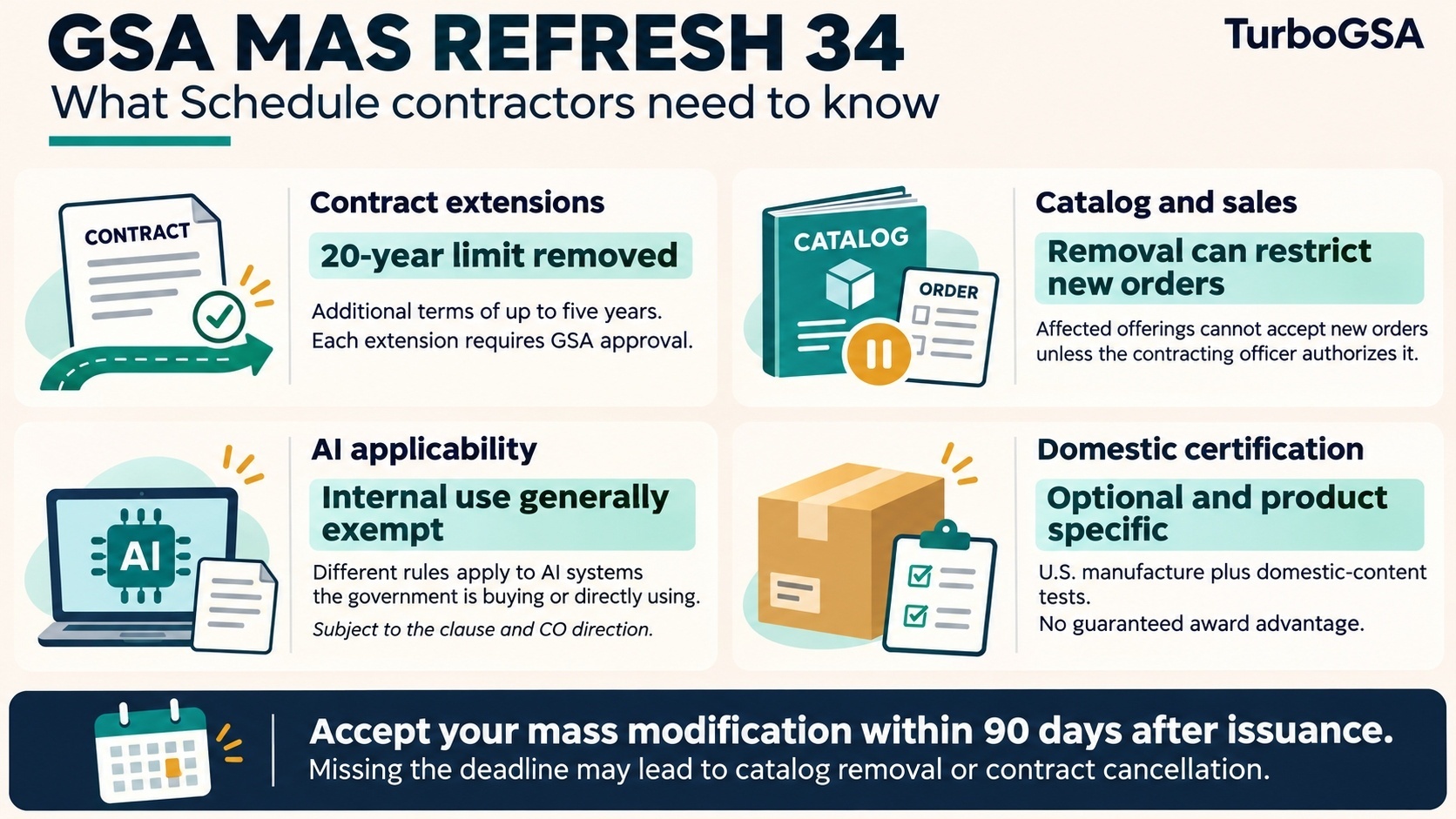
Revised GSAR 552.238-116 lets GSA extend a contract for additional periods of up to five years, with no limit on the number of extensions. Think of it as a lease that can keep renewing, but only if the landlord keeps signing off. Each extension still requires GSA approval, and you still have to meet your reporting, sales, performance, and other obligations to earn it.
Two limits are worth knowing. The change applies to the Schedule contract itself, not to individual task orders or BPAs, which keep their own terms. And it doesn't make extensions automatic.
What to do: If you're near your current expiration date or already preparing a replacement offer, ask your contracting officer how the revised clause will be incorporated and how your next extension will be handled before you change course.
A stale catalog can now cost you orders
An out-of-date catalog used to mean you were harder to find on GSA Advantage. Now it can mean you can't sell at all.
Revised GSAR 552.238-77 requires your pricing and catalog data to be current, accurate, and complete. If it isn't, or if you fall short on other contract requirements, GSA may temporarily remove some or all of your catalog from its systems.
Picture a store whose shelves have been pulled while inventory gets sorted out. Deliveries already on the truck still arrive: existing orders, including exercised options, continue to completion unless the customer says otherwise. But new orders for the affected items are off the table unless the contracting officer authorizes them. That holds even if a customer calls you directly and wants to buy.
There are guardrails. GSA must give you written notice explaining the reasons and, where applicable, a deadline for fixing the problem. The initial removal can last up to 90 calendar days, and the contracting officer can extend it by up to 30 more with notice and an explanation.
What to do: Treat catalog maintenance as a sales issue, not just a compliance chore. Name one person responsible for catalog corrections and CO notices, and make sure your sales team knows right away if an offering is restricted.
Day 91 is not a day you want to meet
Refresh 34 must be accepted no later than 90 days after the mass modification is issued. Use the acceptance date in your actual modification notice. 2
Think of the mass modification like a software update you have to accept, or the app stops taking new orders. Under GSAR 552.238-191(h), failing to accept by the deadline can lead to temporary catalog removal or even contract cancellation. Combine that with the new restriction on orders during removal, and a skipped administrative task becomes a real business problem.
A missed administrative task now carries a direct business consequence.
To be fair to GSA, these are potential remedies, not automatic penalties that fire at 12:01 a.m. on day 91. But "potential" is not a word you want to test with your revenue.
Once accepted, the new terms apply to orders placed after the modification's effective date, including calls under existing BPAs. Orders placed earlier keep the terms they were awarded under.
What to do: Confirm your authorized signer can log in to the mass modification system (passwords have a way of expiring at the worst moment), complete the review early, and keep a copy of the executed modification.
Using AI to help write your reports? Relax (mostly)
Here's the question we're hearing most: if our team uses an AI tool to help write a contract deliverable, like a monthly status report or an analysis for an agency, does the new AI clause suddenly apply to us?
Generally, no. And the reason is simpler than the clause's length suggests.
New GSAR 552.239-7001 is aimed at what the government is buying. It applies when an agency is procuring a large language model (LLM) system, such as a chatbot, an AI agent, or a document tool, where the AI is a material feature and government data goes directly into the model or comes out of it.
When you use AI to help draft a report, the government is buying the report, not the AI. Unless the contracting officer says otherwise, the clause imposes no obligation when AI use is limited to internal business, back-office, operational, or performance-support systems that aren't delivered to or accessed by the government, even if those systems incidentally process government data.
Compare two scenarios. In the first, your analysts use an internal AI assistant to help draft a quarterly report that you then review, finalize, and submit. That's internal use. In the second, you deliver an AI assistant that agency staff log into to analyze their own documents. That's the kind of system the clause was written for. The difference is what the government receives and who uses the tool, not whether your company calls itself an AI firm.
"Mostly" is doing some work in that heading, though. The internal-use exception doesn't waive your other obligations. Keep these in mind:
If you are integrating AI into a federal offering, the clause does apply and covers government data ownership, limits on training and other uses, subcontractor flow-downs, and reporting of material violations and security incidents. Review those requirements with your technology providers before you offer the product.
A new certification nobody can use yet
New GSAR 552.238-130 lets contractors voluntarily certify individual products as FSS domestic end products. Simply listing "USA" as the country of origin doesn't count. 3
To qualify, a product must be on your Schedule and manufactured in the United States. Then one of two cost tests applies:
The certification is your representation, identifying the product name, manufacturer part number, and manufacturer. Resellers acting in good faith may rely on OEM information, and no third-party audit is required. The smart move is to get product-specific support from the manufacturer and keep it on file for each certification.
Now the catch. OMB clearance is still pending, and GSA's class deviation says agencies can't rely on the certification, or its absence, until it's received. Even then, the clause offers no automatic price preference or guaranteed award advantage. It may eventually help buyers spot qualifying domestic products, but for now it's a badge you can earn and no one is allowed to look at.
Certification also doesn't change your existing Trade Agreements Act obligations.
What to do: Don't rush. Evaluate products one at a time, build your documentation, and be ready to certify once OMB clears it.
Quick hits for specific offerings
A few changes only affect certain contractors. If one of these applies to you, take a closer look:
- HACS: The voluntary Incident Response subgroup is scheduled to retire at the end of FY 2027. Review your eligibility for Incident Handling and Event Management now.
- Nitrile gloves: Certain products are targeted for potential removal following contractor outreach.
- HVAC: The refresh describes scope changes. Confirm what they mean for your contract with your CO before acting.
Is Refresh 34 on your to-do list?
Ask yourself these five questions:
- Do you know your exact mass modification acceptance date?
- Can your authorized signer log in to the mass modification system today?
- When was the last time someone checked your catalog pricing and descriptions against what you actually sell?
- Are you within a few years of your 20-year mark, or planning a replacement offer?
- Do you sell an AI-enabled product, or US-made products that might qualify for domestic certification?
If any answer made you pause, it's worth a conversation.
TurboGSA has been helping companies get and manage GSA Schedules since 1998. We'll review how Refresh 34 affects your contract, flag catalog issues before GSA does, and help you plan your next extension.